
'/%3E%3C/svg%3E)
How to optimize 3D printing for complex structures
While additive manufacturing facilitates the fabrication of large structures, its implementation can prove difficult when the geometry is complex. To overcome these issues and meet the challenges of structural optimisation, the CONTINUA exploratory action, led by an Inria researcher Jonàs Martinez Bayona from the MFX project team at the University of Lorraine Inria Centre and Loria, uses computer science and computational mechanics in a novel methodological approach.

© Luis Mollericon Titirico / Inria
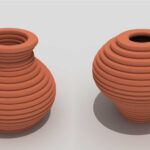
Optimized deposition paths forming a self-supporting structure under gravity.
“The most commonly used additive manufacturing process for large-scale 3D printing involves depositing extruded materials in successive layers through a nozzle mounted on a robotic arm”. Jonàs Martinez Bayona’s description of how a 3D printer works makes it easy to understand the enthusiasm in science and industry for this technology that facilitates the production of very specific parts and large-scale structures. However, those with geometries that require substantial quantities of data to be processed still pose challenges for optimization, particularly when the structures in question are subjected to significant mechanical or environmental stress.
“For example, if you want to print a bridge using as little material as possible, it still has to be designed to resist vehicle traffic and the effects of gravity, so that it doesn’t collapse under its own weight”. Such optimized designs require precise, carefully measured and, above all, even material deposition. “The extrusion flow must not be interrupted, because each time the print head stops or changes direction, defects can appear”. It is this requirement that gave CONTINUA, the exploratory action led by Jonàs Martinez Bayona, its name. The aim was to conduct an in-depth study of manufacturable deposition paths to allow the fabrication of large, complex structures through optimized additive manufacturing.
An innovative approach to optimization
© Luis Mollericon Titirico / Inria
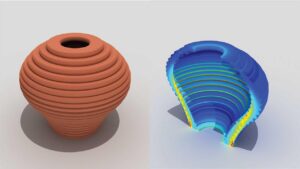
Alternative optimized geometry with corresponding stress distribution.
“Traditional methods of structural optimization for additive manufacturing are based on geometric forms that don’t take the deposition route into precise consideration”, says Jonàs Martinez Bayona. They assume that the geometry of each layer solidifies instantaneously, while the trajectories of each of these layers are calculated a posterioriand are not taken into account during the optimization process. This means they either optimize an intermediate 3D form that is then broken down into paths, which can lead to precision loss, or they rely on a 2D representation of the element to be produced.
“To go back to the example of the bridge, these methods optimize the geometry of the structure. This is then used in algorithms that approximate it to define a series of deposition paths. CONTINUA’s key idea is to carry out the optimization directly on the deposition paths, in order to apply the precise instructions of all those who will contribute to manufacturing the bridge.” This new approach is based on a mathematical formulation of the challenge. This analysis then leads to the elaboration of algorithmic hypotheses, which are themselves assessed by producing samples on the ceramic printer purchased by the exploratory action’s team.
Support from computational mechanics
Jonàs Martinez Bayona addressed “this challenge” in collaboration with Luis Mollericon Titirico, a young PhD student whose work he supervises. “We worked on simple optimization objectives by studying purely circular deposition paths, of which we controlled the length and thickness. The aim was to create a self-supporting structure that maximized volume while withstanding the mechanical stresses caused by its own weight due to the force of gravity.” The structure in question was a truncated cone-shaped vase made of layers of elastic rings.
During the research project, Luis Mollericon Titirico spent six months in Copenhagen, where he received valuable input from Ole Sigmund, a professor of mechanical engineering at Denmark Technical University (DTU). He is an “expert in structural optimization”, explains Jonàs Martinez Bayona, who makes no secret of his admiration for his Danish colleague: “he’s among the best in the world in this field”.
I met Jonàs through colleagues and invited him to Copenhagen to look at a PhD thesis by one of my students. Our shared research interests united us around the CONTINUA project, for which I helped develop the original idea, advised on technical aspects and contributed to discussions on the generation of results. I also worked with Luis during his stay at DTU to carry out research and attend our PhD International Summer University with the TopOpt group, which hosts many visitors. Collaborations such as this with external academics who have different skills are very enriching. They open up fresh perspectives that encourage us to meet challenges and promote technological development.
Ole Sigmund
Professor at Denmark Technical University
Exploring new paths
Jonàs Martinez Bayona has always placed great importance on interdisciplinarity in his research projects: “it’s very enriching both scientifically and in human terms. Ole Sigmund is very open-minded and capable of recognizing the potential of researchers who work in different fields to his own”. CONTINUA’s work ended in late 2025 after a three-year partnership. The results were presented in an article entitled Structural optimization of a stack of elastic rings under gravity that was published in Computer Methods in Applied Mechanics and Engineering, one of the leading journals in computational mechanics.
For Jonàs Martinez Bayona, who stresses that “exploratory actions aim to explore new paths”, their mission is accomplished. “The codes will all be made available as open source data in order to encourage other researchers to continue in the same direction. The long-term objective is to be able to deal with ever more complex shapes”. Pending the bridge that may be made one day using 3D printing, CONTINUA has no doubt contributed to building a different kind of bridge, one towards the future of additive manufacturing.
Source: inria.fr