

Are you a new PhD Student at Loria?
Are you an international PhD student, postdoctoral fellow or researcher?
Here are a few information to prepare your arrival.
The NEASQC (Next ApplicationS of Quantum Computing) project led by Atos is made up of 12 multidisciplinary industrial and academic partners from 8 different European countries. The project works on exploring and developing quantum computing applications with NISQ (Noisy Intermediate Scale Quantum) technologies which will be available in the near future.
At the heart of this global race involving both public laboratories and private multinationals, the quantum computer, envisaged in the early 1980s by Richard Feynman, winner of the 1965 Nobel Prize in Physics, sparked a true revolution. However, amid promises and sensational announcements, it is difficult to know where this technology really stands, and what its actual applications will be. Unlike a classical computer and similar devices such as smartphones, a quantum system does not use binary bits, namely the two values of one and zero. It is based on qubits, which thanks to the unique properties of quantum objects, display an increasing number of different states with the addition of new units. Each extra qubit doubles computing power. However, this firepower is not adapted to all situations.
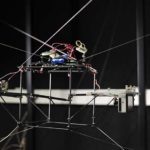
Flying insects have developed effective strategies for navigating in natural environments. However, the experimental study of these strategies remains challenging due to the small size of insects and their high speed of motion: today it is only possible to study insects that are “tethered” or in stationary flight. Scientists from the CNRS, Université de Lorraine, and Inrae* have developed the first cable-driven robot that can follow and interact with free-flying insects.
More information: Read the press alert on CNRS website

Jean-Baptiste Mouret, Research Director Inria in team Larsen common to Inria and Loria, has won the Award for Outstanding Paper of the Decade from the ISALsociety for The evolutionary origins of modularity,
Renaud Vilmart is a doctoral student at the Université de Lorraine and belongs to the joint Inria-Loria Mocqua team. He was awarded the Kleene Awardf or the best student paper at LICS, the major conference on logic in computer science, which took place in Vancouver from June 24thto 27th.